Genetics is the study of genes, how they work, how they vary between people, and how they can be inherited from one generation to the next.
What are genes?
Genes are sections of DNA that contain instructions used by our bodies to grow, develop and function. They influence many different characteristics, from features such as eye and hair colour to how our cells and organs work.
Sometimes a change in DNA can affect how a gene works and contribute to a genetic condition. However, many changes in DNA are harmless and do not cause a genetic condition, while the effects of some changes remain uncertain.
Genes are arranged on structures called chromosomes. Most of our cells contain 46 chromosomes, organised into 23 pairs. We usually inherit one chromosome in each pair from our mother and one from our father. As a result, we usually have two copies of most genes, one inherited from each parent.
Chromosome pairs 1–22 are called autosomes and are not involved in determining biological sex. Chromosome pair 23 consists of the sex chromosomes, X and Y. Females typically have two X chromosomes (XX), one inherited from each parent, while males typically have one X and one Y chromosome (XY), with the X inherited from the mother and the Y from the father.
What is a genetic condition/disorder?
A genetic condition can be caused by a change in DNA, known as a genetic variant, that affects how a gene functions. The term “mutation” has historically also been used to describe genetic changes, particularly those associated with disease.
Variants can be classified according to the available evidence about their effect:
Pathogenic: there is sufficient evidence that the variant causes or contributes to a genetic condition.
Likely pathogenic: there is strong evidence that the variant causes or contributes to a genetic condition, but the evidence is not sufficient for it to be classified as pathogenic.
Variant of uncertain significance (VUS): there is currently not enough evidence to determine whether the variant is associated with a genetic condition. As further genetic information becomes available, a VUS may later be reclassified.
Likely benign: there is strong evidence that the variant does not cause a genetic condition.
Benign: there is sufficient evidence that the variant does not cause a genetic condition.
To learn more about the basics of genetics and inheritance, you can view this video from the European Reference Network (ERN).
Single gene disorders
Single gene disorders are caused by a change in a single gene. Because one gene is primarily involved, the pattern of inheritance can sometimes be recognised within a family. Genetic counsellors can help explain how a condition may be inherited and what this may mean for an individual and their family.
Common inheritance patterns for single gene disorders include autosomal dominant, autosomal recessive and X-linked inheritance.
Undiagnosed conditions
Sometimes, a genetic condition is suspected but genetic testing does not identify a clear genetic cause. This may be because the underlying genetic change cannot yet be detected or is difficult to detect with current testing, or because its significance is not yet understood. However, this is not uncommon. In our UK specialist adult and paediatric leukodystrophy cohorts, around 40% of people remain without a genetic diagnosis after current testing.
Undiagnosed genetic conditions are sometimes described as syndromes without a name (SWAN). For leukodystrophies where the underlying cause has not been identified, Alex TLC uses the term Unnamed Leukodystrophies.
What is genetic testing?
Genetic testing looks for changes in DNA that may help explain a medical condition, confirm a diagnosis, or determine whether someone carries a genetic variant associated with a condition already identified in their family.
Genetic testing usually involves taking a sample of blood, although other samples such as urine or tissue may sometimes be used. DNA is extracted from cells in the sample and analysed using specialised laboratory equipment to determine the sequence of nucleotides or bases in DNA. The bases are adenine (A), thymine (T), cytosine (C), and guanine (G) and the order the bases are in provide information to cells on how to develop and function. Understanding these sequences helps us understand the function of genes and other parts of the genome.
Powerful computer programs then process and filter the large amount of sequence data generated. Scientists and clinicians with expertise in genetics then review the findings, focusing on genes and types of genetic change that may be relevant to the person’s symptoms, to determine whether a variant could explain the condition.
Sometimes, testing other family members can help interpret a genetic result. For example, testing a person together with both biological parents (known as trio testing) can show whether a variant was inherited or occurred for the first time in that person (de novo). Testing other affected or unaffected relatives can also help determine whether a variant is likely to be related to the condition. This is called segregation analysis.
Having samples from family members available can therefore improve the interpretation of genetic testing.
How long does genetic testing take and when will I get my results?
Predictive testing: This is usually offered when a genetic variant associated with a condition has already been identified in the family, and a relative who does not currently have symptoms wants to know whether they have inherited it. Depending on the condition, the result may provide information about their own chance of developing the condition in the future. Results may take around 8–12 weeks, although this varies between hospitals.
Carrier testing: This is sometimes used to establish whether someone is a carrier of a genetic condition and could pass a variant on to their children. Results may take around 8–12 weeks, although this varies between hospitals.
Diagnostic genetic testing: When someone already has symptoms but the underlying genetic cause is not known, testing can take longer. Sometimes the clinical features suggest a particular gene or small group of genes. In other cases, many different genes could potentially cause a similar condition.
Depending on the suspected condition, testing in the UK may include a chromosomal microarray, testing of an individual gene or gene panel, or whole genome sequencing. These tests can examine anything from a small number of genes to hundreds or thousands of genes.
Whole genome sequencing results may currently take around a year in some specialist services due to the complexity of analysing and interpreting large amounts of genetic data, the large number of people undergoing testing, and backlogs within genomic laboratory services. Turnaround times may improve as laboratory capacity, technology and analysis pathways continue to develop.
Genetic testing does not always provide an answer. Our understanding of genetic variation, and the technologies used to detect and interpret it, are continually developing. This means that a genetic cause that cannot be identified today may sometimes become identifiable in the future.
What is genetic counselling?
Genetic counselling provides information and support to individuals and families who have, or may be at risk of, a genetic condition. Genetic counsellors can help people understand genetic test results, how a condition may be inherited, what this could mean for other family members, and the options available to them. They can also support individuals and families in making informed decisions that are right for them.
Genetic counselling may be particularly helpful before or after genetic testing, when considering predictive testing, or when there are questions about inheritance or having children.
Learn more about genetic testing and counselling here.
In the UK, genetic counselling is available through regional clinical genetics services. Your doctor or specialist team can refer you if appropriate.
Reproductive options
Where relevant, genetic counsellors can discuss reproductive options for people who are concerned about passing on a genetic condition. Depending on the condition and individual circumstances, these may include:
prenatal diagnostic testing during pregnancy, such as chorionic villus sampling (CVS) or amniocentesis
IVF with pre-implantation genetic testing for monogenic disorders (PGT-M, previously known as PGD)
use of donor eggs or donor sperm
for some mitochondrial DNA conditions, mitochondrial donation
Specialist genetics and fertility teams can explain which options may be appropriate for an individual or family.
Inheritance describes how genetic variants can be passed from parents to children. There are several different patterns of inheritance, including those described below.
X-linked recessive: The genetic variant is located on the X chromosome. Males typically have one X and one Y chromosome, while females typically have two X chromosomes. Because males have only one X chromosome, a disease-causing variant on that chromosome is more likely to cause the condition. Females who have a disease-causing variant on one X chromosome may have no symptoms or milder symptoms, although this can vary between individuals.
Autosomal dominant: In autosomal dominant conditions, a disease-causing variant in one copy of a gene is sufficient to cause the condition. We usually have two copies of each gene, one inherited from each parent. The variant may be inherited from an affected parent, or it may occur for the first time in the individual as a de novo variant.
Each child of an affected person has a 50% chance of inheriting the variant. Whether someone who inherits the variant develops symptoms, and how severe those symptoms are, can vary depending on the condition.
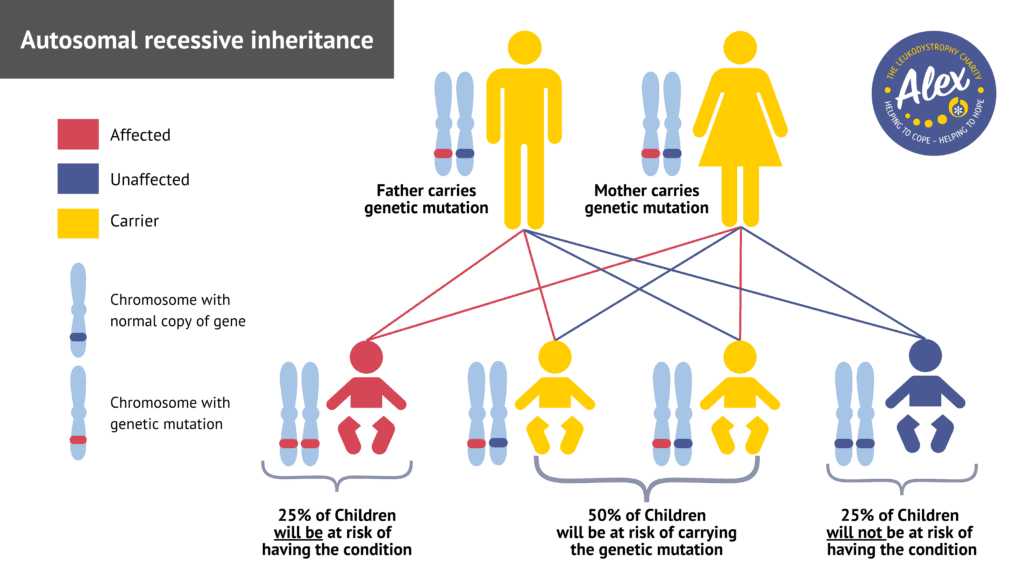
Autosomal recessive: In autosomal recessive conditions, disease-causing variants are usually present in both copies of a gene. We usually have two copies of each gene, one inherited from each parent. A person with an autosomal recessive condition will usually have inherited one disease-causing variant from each parent.
Parents who each carry one disease-causing variant are usually unaffected themselves. For each pregnancy, there is a 25% chance that the child will inherit both variants and have the condition, a 50% chance that the child will inherit one variant and be a carrier without having the condition themselves, but with the possibility of passing the variant on to their children, and a 25% chance that the child will inherit neither variant.
Mitochondrial disease: Mitochondrial diseases can be caused by genetic variants in either mitochondrial DNA (mtDNA) or nuclear DNA. Mitochondrial DNA is found within mitochondria, the energy-producing organelles in our cells, and contains 37 genes. Nuclear DNA is contained within our chromosomes and includes around 20,000–25,000 genes. Mitochondrial DNA is almost always inherited from the mother.
Heteroplasmy: A person can have a mixture of mitochondria containing normal mitochondrial DNA and mitochondria containing a genetic variant. This is called heteroplasmy. The proportion carrying the variant can differ between tissues and between family members, which can contribute to differences in symptoms and severity.
The inheritance pattern depends on where the disease-causing variant is located. Variants in mitochondrial DNA are almost always inherited from the mother, whereas mitochondrial diseases caused by variants in nuclear genes may follow autosomal recessive, autosomal dominant or X-linked inheritance. Some nuclear genetic variants may also arise de novo.
For some people at risk of passing on a serious mitochondrial DNA condition, specialist reproductive options may also include mitochondrial donation treatment: https://www.hfea.gov.uk/treatments/embryo-testing-and-treatments-for-disease/mitochondrial-donation-treatment
A mitochondrial specialist or genetic counsellor can advise whether this may be relevant.
Consanguinity and shared ancestry: When parents are biologically related, for example cousins, they are more likely to carry the same rare genetic variant inherited from a shared ancestor. In some populations or communities, people may also share genetic variants because of more distant common ancestry, even when no close family relationship is known. Both situations can increase the chance of some autosomal recessive conditions occurring in children.
De novo variants: Sometimes a genetic variant occurs for the first time in an individual and is not detected in either parent. This is called a de novo variant. In many cases, the chance of the same de novo variant occurring in another child is low, but it is not always zero because a parent may occasionally carry the variant in only some of their egg or sperm cells (germline mosaicism). A genetics specialist can provide advice about the recurrence risk for an individual family.
Further information
The following resources provide further information about genetics, genetic testing and genetic counselling.
From Alex TLC:
Genetics explained – what does “genetic testing” mean? – Dr James Poulter
Dr James Poulter’s presentation from Alex TLC’s Community Weekend 2025 provides an accessible overview of genetics and genetic testing, click here to watch.
Learn more about genetic testing and counselling here.
Other useful resources:
Genetic Alliance UK
Genetic Alliance UK provides information about genetic, rare and undiagnosed conditions, as well as genetic testing and genetics services.
GE Notes – Knowledge Hub from Genomics Education provides information about genetic conditions, genomics, therapies, and technologies for healthcare professionals working in the NHS.
The European Reference Network (ERN) is a network between European countries to bring together centres of expertise to discuss patient cases affected by rare, low-prevalence, and complex diseases. Allowing advice on appropriate diagnosis and treatment options. This video from the ERN can help you understand more about the basics of genetics and inheritance.
The National Human Genome Research Institute (NHGRI)
The NHGRI are focused on advances in genomics research. They were the first to sequence the human genome and are working to improve genomic technologies that accelerate breakthroughs and improve lives. They also provide information on genomics in their genetics glossary.